
Victorian Terrace Living Room Ideas That Keep the Light
Victorian terrace living room ideas work best when you design around the room you have, not the room you wish you had. Measure the chimney breast and the alcoves, choose warm paint that suits a north-facing room, and pull the seating away from the walls. Every idea below keeps the light, and every price was checked on 21 Nov 2026.
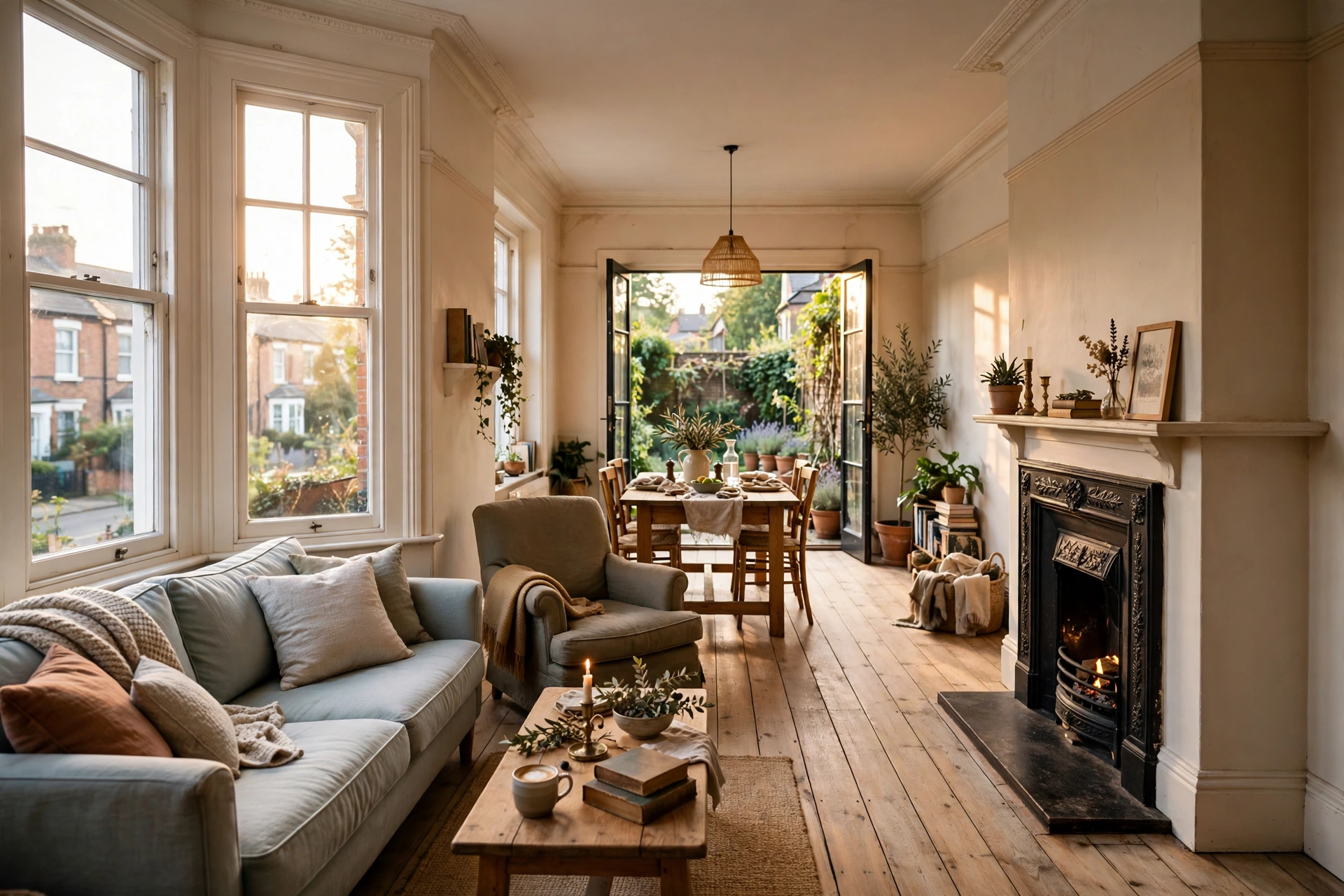
A Victorian terrace front room is one of the best rooms in British housing and one of the hardest to furnish. Tall ceilings near three metres, a sash or bay window at one end, a chimney breast in the back wall, and alcoves either side. It is long, narrow, and often one window deep, so it can feel like a corridor with a sofa in it. Layout, colour, and light fix most of that.
Victorian terraces were built between 1837 and 1901, and the front room was the parlour, the best room in the house. It still has the features that made it special: cornicing, a ceiling rose, deep skirting, sash windows, and a cast iron fireplace. This guide shows you how to work with them, with 17 ideas, measured layouts, and real costs.
Read the Room First
Before you buy a single cushion, measure the room: length and width, chimney breast depth, often 30 to 40 cm, alcove sizes, window sill height, radiator position, and door swing. Draw it to scale, then mark a walking route of about 75 cm from the door. What is left is your furniture footprint, and it is usually smaller than it looks.
Stand in the doorway and look at what the room gives you: a chimney breast with an alcove either side, a sash window at one end, a ceiling near three metres, and a walkway along one wall. That walkway matters more than anything else. Protect it and the space feels easy. Block it and the whole room feels tight.
Layout: 4 Ideas for a Narrow Room
Most narrow living rooms are furnished along the walls, which creates a bowling alley down the middle and leaves nowhere comfortable to sit and talk. These four ideas fix that.
1. Swap the corridor layout for a loose L
Put the main sofa across the far end of the room, facing the fireplace or the window, then angle an armchair beside it. The seats end up within two to three metres of each other, and the middle stays open. This loose L is the single biggest improvement you can make, and it costs nothing.
2. Choose a slim sofa on legs
Depth matters more than width in a narrow room. A sofa with slim arms, around 10 cm wide instead of 25 cm, and a raised base on legs, gives you floor visibility. If the room is under three metres wide, skip the second sofa and use one sofa plus two armchairs.
3. Face two seats towards each other
A pair of armchairs opposite a two-seater works better than one long sofa hugged against a wall. The seats face each other across a rug, and nobody sits sideways to the conversation. Keep facing seats about 120 to 150 cm apart.
4. Use round or oval tables
A circular coffee table or a small round side table softens all those right angles and is easier to walk around than a square one. Leave 70 to 90 cm between furniture.
Colour: 4 Ideas for North-Facing Rooms
Colour does more work than furniture in a Victorian terrace, because the light is the problem. North-facing rooms get cool, slightly blue light, and the wrong paint makes that worse.
5. Pick a warm off-white, never brilliant white
Brilliant white paint in a north-facing room turns grey and flat by mid-afternoon. Choose a warm off-white, a soft plaster tone, or a pale grey with a hint of green or pink underneath. Paint a test patch and look at it at four o’clock, not at noon.
6. Use tonal layering, not contrast
For a narrow room, tonal layering usually beats contrast. Pick one colour and use it on walls, ceiling, woodwork, and alcoves in slightly different strengths. Painting skirting and architraves the same colour as the wall removes lines that chop the room into strips.
7. Put dark colour at the far end only
Dark paint is not the enemy of a small room, but placement is everything. A deep colour on the wall you face as you walk in will pull you forward and make the room feel longer. A deep colour on the window wall swallows the light. Keep window reveals light.
8. Paint the woodwork the same colour as the walls
Resist the urge to outline every feature in brilliant white. Painting cornice, skirting, and architraves in the same colour as the walls, in a hard-wearing eggshell, makes the room read calmer and taller.
Alcoves and Fireplace: 3 Ideas
The chimney breast and the alcoves are the most useful space in a Victorian terrace and the most frequently wasted. Treat them as the structure of the scheme, not as decoration.
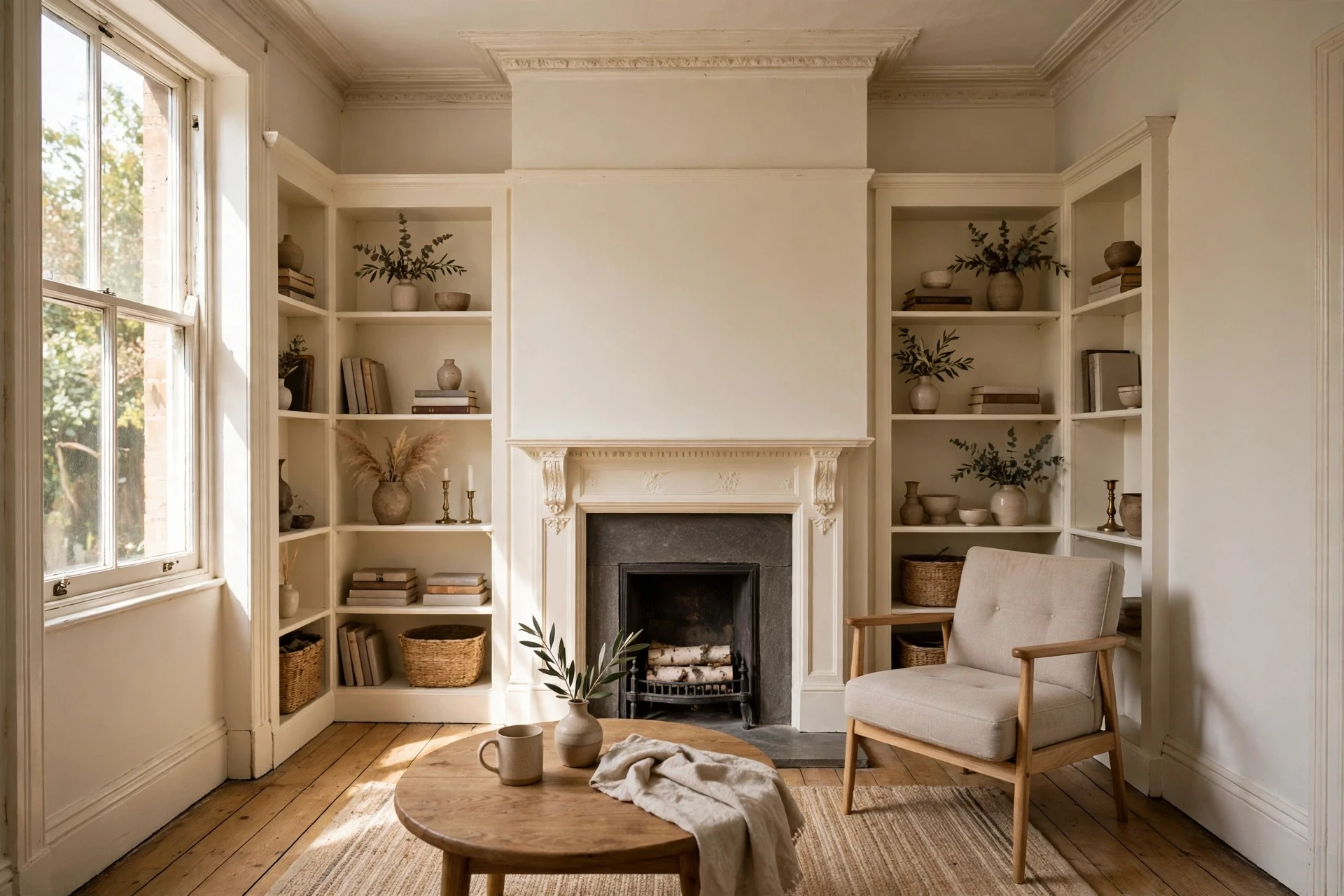
9. Build shelving into the alcoves
Built-in shelving painted the same colour as the wall reads as part of the architecture, and it draws the eye upward, which makes a narrow room feel taller as well as tidier. Keep the shelves around 28 to 30 cm deep: enough for paperbacks and storage boxes.
10. Use freestanding pieces when you cannot build in
Freestanding pieces work if they are slim and light-looking. An IKEA BILLY bookcase, 80 by 28 by 202 cm, costs £55, and the BILLY with OXBERG glazed doors costs £95. A KALLAX unit, 77 by 147 cm, costs £49, down from £60, and the smaller 77 by 77 cm unit costs £29.
11. Treat the fireplace as the anchor
Treat the chimney breast as an anchor rather than an obstacle. If the cast iron fireplace survives, restore it: clean the iron, repair the tiled surround, and let it be the focal point. If the fireplace has gone, a shallow mantel or a low media unit across the breast keeps the symmetry.
Windows and Light: 3 Ideas
Light bouncing off a pale ceiling reads as height. Light bouncing off a pale floor reads as space. Try to give it both.
12. Hang curtains high and wide
Hang curtains as high and as wide as the room allows, at the ceiling line, extending 20 to 30 cm beyond the window reveal on each side. When drawn back they should sit over wall, not glass. Keep the glass clean: on a dark winter afternoon a clean sash is worth more than any lightbulb.
13. Choose Roman blinds or cafe shutters for sash windows
Roman blinds suit sash windows well because they stack tightly at the top and leave the reveal clear. Half-height cafe shutters on the lower half give you privacy with the top panes still open to the sky.
14. Layer the lighting, and hang a mirror opposite the window
A single pendant in the centre of a long, narrow room lights the middle of the ceiling and very little else. Put it on a dimmer and add three other sources: wall lights in the alcoves, a floor lamp angled up to wash the ceiling, and a table lamp on a console. Warm white bulbs around 2700K flatter both skin and paintwork.
Floor and Finishing Touches: 3 Ideas
15. Run the same flooring through the doorway
Run the same flooring through the doorway and the room reads as larger, because the eye finds no line to stop at. Pale timber, engineered boards, or a wool carpet in a soft neutral all work. A dark floor makes the scheme feel lower.
16. Buy a rug that is bigger than feels natural
Add one rug that is bigger than feels natural. A rug under the front feet of the sofa and the armchairs holds the seating group together. Choose a rug in a tone close to the floor rather than an abrupt contrast.
17. Let one element carry the accent
Keep to two or three colours and let one element carry the accent: the fireplace tiles, a door, or a single piece of upholstery. A little warmth stops a light room feeling clinical.
What It Costs: Real UK Prices
Every price below was checked on 21 Nov 2026 from the makers’ listings and UK price guides. Paint prices include VAT, and labour figures are for a single living room.
| Item | Cost | What it covers |
|---|---|---|
| Dulux Matt Emulsion, 2.5L | £27 | Walls and ceiling, up to 14 sq m per litre |
| Dulux Easycare Washable and Tough Matt, 2.5L | £33 | Same coverage, stain repellent, for busy rooms |
| Farrow and Ball Estate Emulsion, 2.5L | £61 | Premium chalky matt, heritage colours |
| IKEA BILLY bookcase, 80 x 28 x 202 cm | £55 | One alcove, open shelving |
| IKEA BILLY with OXBERG glazed doors | £95 | Same size, doors keep dust off |
| IKEA KALLAX shelving unit, 77 x 147 cm | £49 | Was £60, low wide unit for an alcove |
| Painting labour, one living room | £200 to £350 | Mid-range, walls and ceiling |
| DIY paint cost, one room | £55 to £120 | Mid-range Dulux, two coats |
A full DIY refresh, paint plus two alcove bookcases, costs about £165 with Dulux and BILLY, or about £200 with Farrow and Ball paint. Add a professional painter and the same job costs about £365 to £515 with mid-range paint.
For paint colour help in other rooms, see our guide to kitchen cupboard paint colours UK, and for small home layouts, see small galley kitchen ideas UK. Warm shades and light temperature also matter in the bedroom, as covered in warm bedroom colors for cozy sleep.
TV or Fireplace: How to Decide
The fireplace and the television both want the same wall, and in a narrow room only one can win. If you use the fireplace, even occasionally, it wins. Put the television in an alcove on a low unit, or on a swing arm that folds flat. If the fireplace is decorative, the television can take the breast, but keep it low, at seated eye level.
Do not put the television on the window wall. It will fight the light all day, and the seating will end up facing away from the fireplace and the window. Do not put it above the fireplace either, because a high screen means a sore neck.
Window Dressing in Detail
Sash windows are the best feature of a Victorian terrace and the easiest to get wrong. Full-length curtains hung at the ceiling line make the window look taller, but they must clear the radiator below, or they will trap heat and fade. If the radiator sits under the window, use a sill-length blind instead.
For privacy on a street-facing room, half-height cafe shutters on the lower half give you privacy with the top panes still open to the sky. Full shutters cut the light in half, so use them only if the room gets strong sun. Keep the glass clean and the sill clear.
An Order of Work That Saves Money
Do the work in this order and you will not pay twice for the same job. First, clear the room and live with it for a week. You will learn where you want to sit, and where the light falls at four o’clock. Second, sort the lighting before you choose paint. Third, paint everything in one tonal family. Fourth, buy furniture last, measured against the walkway you drew with masking tape.
Do those four things in that order and a narrow, light-hungry Victorian room becomes one of the most comfortable in the house.
Mistakes to Avoid
Painting a north-facing room brilliant white is the most common mistake, because the cool light turns it grey by afternoon. Pushing all the furniture against the walls is the second, because it creates a corridor down the middle. Painting the window wall dark is the third, because it swallows the light.
Two more mistakes are worth naming. The first is buying furniture before measuring, because a sofa 10 cm too deep can block the walkway for years. The second is ripping out original features. A dado rail added in the 1980s can go, but cornicing, a ceiling rose, and a cast iron fireplace are almost impossible to fake afterwards. If your home is listed or in a conservation area, check with your local planning authority first.
Frequently Asked Questions
How do you arrange furniture in a narrow Victorian terrace living room?
Use a loose L: put the main sofa across the far end of the room, facing the fireplace or the window, then angle an armchair beside it. Keep a walking route of about 75 cm from the door and use a round coffee table.
What colour should I paint a north-facing Victorian living room?
Choose a warm off-white, a soft plaster tone, or a pale grey with a hint of green or pink underneath. Brilliant white turns grey and flat in cool north light. Use one colour on walls, ceiling, woodwork, and alcoves, and put dark colour on the far wall only.
How much does it cost to paint a Victorian terrace living room?
DIY paint costs about £55 to £120 for a room with mid-range Dulux, or about £122 for two tins of Farrow and Ball Estate Emulsion at £61 per 2.5L tin. A professional painter charges about £200 to £350 per room with mid-range paint, or £300 to £500 with premium paint.
What do I do with the alcoves in a Victorian terrace?
Build shelving into the alcoves, painted the same colour as the walls, at 28 to 30 cm deep. If you cannot build in, use slim freestanding pieces: an IKEA BILLY bookcase costs £55, and a KALLAX 77 by 147 cm unit costs £49. Keep one alcove open if the other is full.
Should the TV go above the fireplace in a Victorian terrace?
Usually no. The television and the fireplace both want the same wall, and a high screen means a sore neck. If you use the fireplace, put the television in an alcove on a low unit. If the fireplace is decorative, the television can take the breast, but keep it low, at seated eye level.