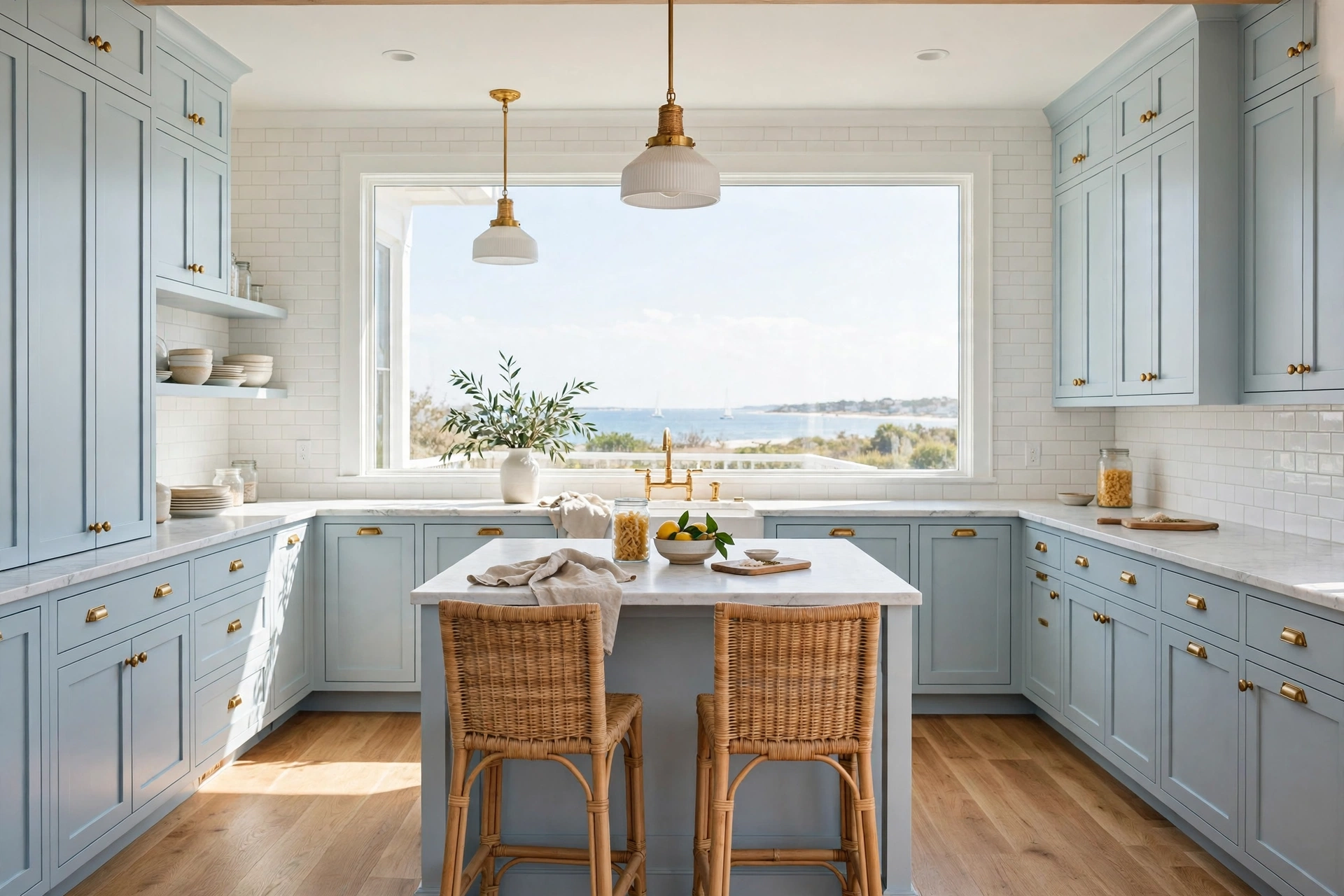
Navy Blue and Brass Kitchen Ideas That Feel Rich, Not Dark
Navy blue and brass kitchen ideas work best when navy carries the lower cabinets and brass carries the hardware, faucet and lights. Pick a tested navy such as Sherwin-Williams Naval SW 6244 or Benjamin Moore Hale Navy HC-154, size the pulls to the drawer, and keep the lighting warm at 2700K to 3000K.
Navy and brass is one of the most reliable pairings in kitchen design. Navy brings depth, brass brings warmth. The formula stays the same everywhere: one deep blue, one warm metal, one pale stone, good light.
The catch is that navy punishes guesswork. The wrong shade turns gray, the wrong brass fights the cabinets, and small pulls disappear against a dark door.
Start With the Two Tone Rule
The rule is simple: dark low, light high, brass tying the two together.
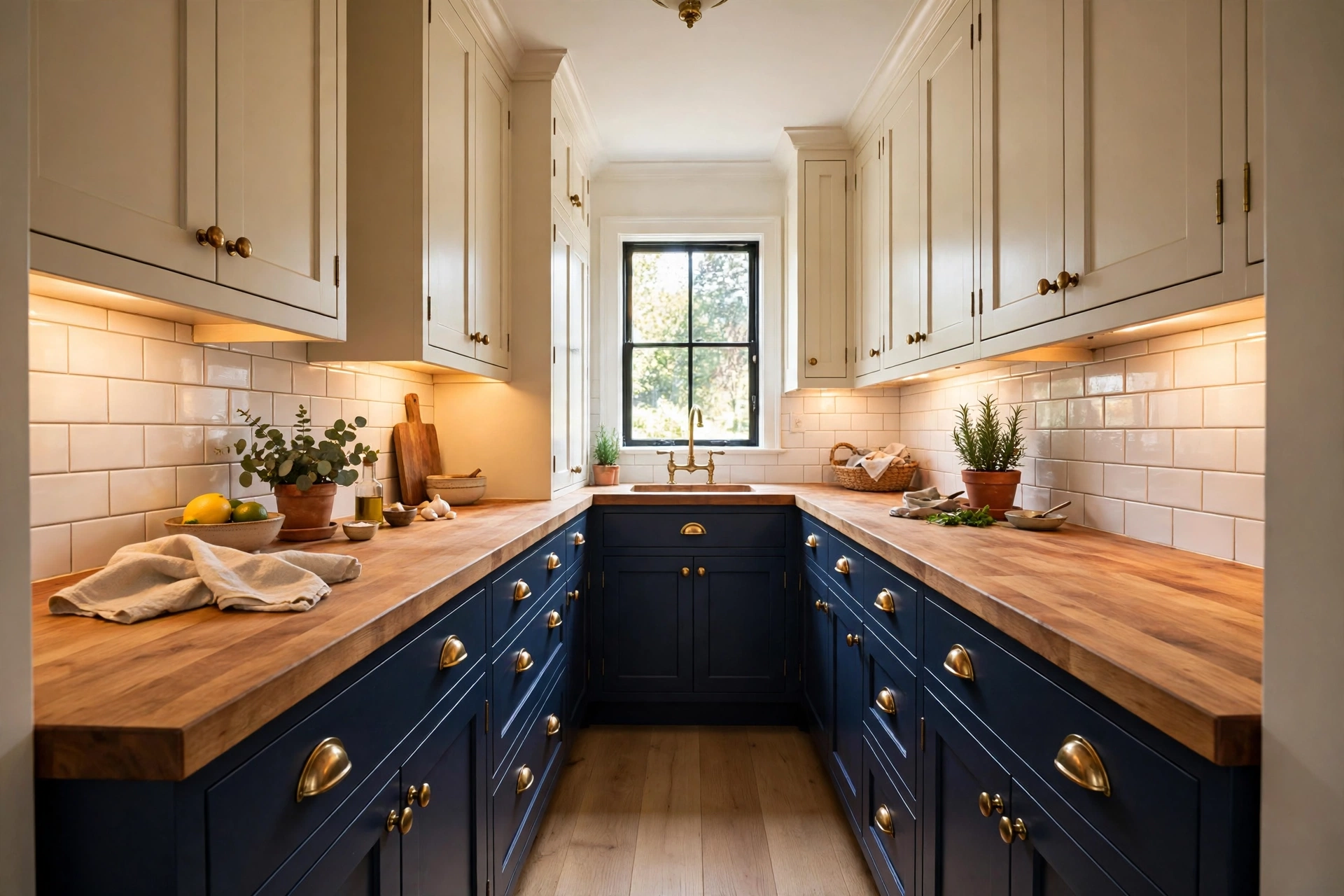
1. Navy lowers, cream uppers, brass knobs
Paint the base cabinets navy and the wall cabinets cream, then use the same brass knobs on both. The cream uppers keep a small kitchen from feeling top heavy, and matching hardware makes the split look intentional.
2. Navy island, white perimeter, brass D-ring pulls
Paint only the island navy and keep the rest white. Brass D-ring pulls suit this version well. Keep the island countertop white, because a dark island with a dark top loses the contrast.
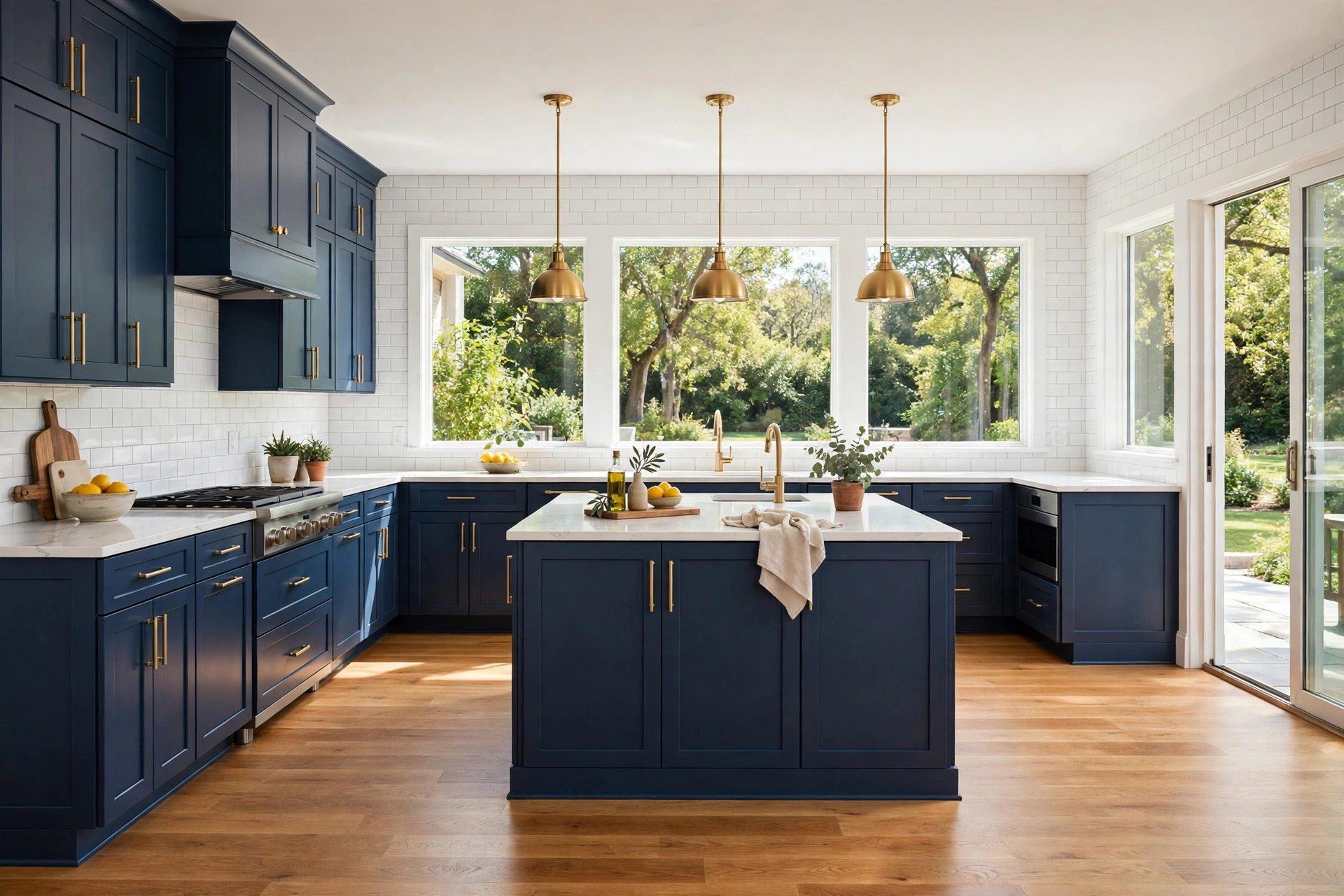
3. Full navy shaker with brass bar pulls
A full navy kitchen works when the room has light to spare. Big windows, a pale floor, and a white countertop stop the navy from closing in. Slim brass bar pulls keep the sight lines clean.
4. Navy pantry wall with brass finger pulls
A floor to ceiling navy pantry wall makes a serious statement without touching the cooking run. Slim brass finger pulls keep the hardware minimal.
Paint Codes That Actually Work
Rivals name paint codes, but none tell you which navy suits which light. The light reflectance value tells you how much light each paint bounces back, and a low number means a darker paint.
| Navy paint | Code | Light value | Best light |
|---|---|---|---|
| Sherwin-Williams Naval | SW 6244 | 4 | Bright, south |
| Benjamin Moore Hale Navy | HC-154 | 6.3 | Any light |
| Farrow and Ball Hague Blue | No. 30 | 7 | North, east |
| Behr Naval Shadow | S470-7 | Low | Bright, south |
Benjamin Moore Hale Navy HC-154 is the safest all round choice, because its light value of 6.3 holds its color in dim light. Sherwin-Williams Naval SW 6244 is deeper, with a light value of 4, so save it for bright rooms or the island only. Farrow and Ball Hague Blue No. 30 is the warmest navy here, and it suits north facing rooms where a cold navy would turn gray. Always paint a large test patch and check it at four in the afternoon.
Brass Finishes Compared
Brass is not one finish. Polished, brushed, unlacquered, and aged brass each read differently against navy, so match the finish to the kitchen style, then keep it consistent.
5. Polished brass for modern gloss kitchens
Polished brass is bright, reflective, and formal. It suits gloss navy slab fronts and marble counters, because the shine plays off the gloss. The trade off is fingerprints, so keep a microfiber cloth in a drawer.
6. Brushed brass for soft, lived in kitchens
Brushed brass, also sold as satin brass, has a soft grain and almost no shine. It is the most forgiving brass against navy, because it warms the blue without competing with it. It hides fingerprints, and it suits shaker doors and butcher block counters.
7. Unlacquered brass that ages with patina
Unlacquered brass has no protective coating, so it darkens and develops a living patina. Against navy it glows like candlelight. The trade off is maintenance, because the patina is uneven at first.
8. Aged brass for traditional kitchens
Aged brass, also sold as antique brass, arrives pre darkened with a warm brown tone. It suits traditional navy kitchens, cup pulls, and a bridge faucet, because its muted tone never shouts. It is the lowest maintenance brass here, because new marks blend into the aged finish.
Hardware Size Chart
Rivals show hardware but never say what size to buy. Measure the drawer front first, then pick the pull from this chart. Center to center means the distance between the two screw holes.
| Drawer or door width | Pull size, center to center | Best shape |
|---|---|---|
| Under 12 inches | 3 inches, or a knob | Knob or small cup pull |
| 12 to 18 inches | 3-3/4 inches | Bar pull or cup pull |
| 18 to 24 inches | 5-1/16 inches | Bar pull |
| 24 to 30 inches | 6-5/16 inches | Bar pull |
| Over 30 inches | 8-13/16 inches or two pulls | Long bar pull |
A pull should span about one third of the drawer width, never less than a quarter. Keep every pull the same length on every drawer of the same width.
The Small Kitchen Version
A small kitchen does not need less navy, it needs the navy in the right places.
9. Galley kitchen, navy on one wall only
In a galley, paint only one wall of cabinets navy and keep the other wall cream or white. The navy wall becomes the feature, the pale wall keeps the corridor bright, and a long runner rug breaks up the dark lower cabinets.
10. Small kitchen, navy island only
A small kitchen with a peninsula or a rolling island can carry the whole color story on that one piece. Paint the island navy, keep everything else cream, and add two brass bar stools. Repainting one island is a weekend job.
11. Navy backsplash tile, brass shelf brackets
If painting cabinets feels like too much, bring the navy in as tile. A navy subway or zellige tile backsplash with brass shelf brackets gives you the color at eye level, and cream cabinets keep the room light.
12. Open shelves to break up navy walls
Open wood shelves on brass brackets break up a navy wall without adding another color. They keep the wall from feeling closed in. Style the back row practical and the front row curated.
Lighting: The 2700K to 3000K Rule
Light decides whether navy feels rich or feels like a cave. Cool daylight bulbs make navy look gray, while warm bulbs bring the blue back. Every bulb should sit between 2700K and 3000K.
13. Brass pendants over the island
Three brass dome pendants over the island light the work surface and repeat the brass from the hardware at eye level. Hang them 30 to 36 inches above the countertop. Match the pendant finish to the pulls.
14. Under cabinet lighting at 2700K to 3000K
Under cabinet LED strips are the most important light in a navy kitchen, because they wash the countertop and bounce light off the pale backsplash. Choose warm white strips at 2700K to 3000K, never daylight.
15. One brass faucet that matches the pulls
The faucet is the biggest piece of brass in most kitchens, so it sets the tone for every smaller piece. Choose the faucet finish first, then buy pulls, knobs, and lights in the same finish.
Surfaces That Keep Navy From Feeling Heavy
Paint is only half the pairing. The countertop, the backsplash, and the floor decide whether the scheme looks collected.
16. White marble or quartz counters
White marble with warm gold veining is the easiest countertop for navy. White quartz is the practical version, because it never etches and it wipes clean. Avoid dark granite or black counters.
17. Butcher block to warm the navy
Butcher block is the warmest countertop for navy, and it works best on the island. Its honey tone cuts the darkness just enough to keep the space feeling grounded. Oil it near the sink edge, where wood counters show wear first.
18. Zellige or subway tile backsplash
A handmade zellige tile backsplash adds texture behind the range, because its irregular surface catches the light in a way flat subway tile cannot. Cream zellige keeps the wall pale, while white subway tile with warm gray grout gives more definition.
What a Brass Hardware Swap Costs
Every price below was checked on 23 Nov 2026 from current retailer listings. Prices are per piece in US dollars, before tax. A hardware swap is the cheapest way into this look, because it needs no painter and no new cabinets.
| Hardware | Price each | Best for |
|---|---|---|
| Amerock brass bar pull | $11.00 to $36.71 | Drawers, any width |
| Amerock brass knob | $6.42 to $10.99 | Doors |
| Amerock brass bar pull, 10 pack | $35.63 to $88.14 per pack | Full kitchen swap |
| Benjamin Moore Advance, per gallon | $62.44 | Cabinet paint |
| Sherwin-Williams Emerald Urethane, per gallon | $95 to $110 street | Cabinet paint |
| Behr Premium Plus, per gallon | $40.98 | Budget cabinet paint |
A typical kitchen has about 20 doors and drawers. A budget swap with two 10 packs of brass bar pulls costs about $71 to $176, and it takes an afternoon with a drill and a template. A midrange swap costs about $220 to $740. Knobs are cheaper, at about $128 to $220 for 20.
If you repaint the cabinets navy as well, allow two gallons of enamel. A budget route with Behr Premium Plus costs about $82, a midrange route with Benjamin Moore Advance costs about $125, and a premium route with Sherwin-Williams Emerald Urethane costs about $190 to $220.
For a second pairing in the same color family, see our guide to cream kitchen cabinets with black hardware ideas. For the wider budget picture, our sage green and cream kitchen color ideas guide breaks down a full paint only refresh.
Unlacquered Brass Care
Unlacquered brass is the most beautiful brass against navy and the most demanding, and its patina is the point.
19. Let the patina settle before you judge it
New unlacquered brass looks bright for a week, then darkens unevenly for a month. That patchy stage worries most people, who polish it back to bright and restart the cycle. Leave it alone for six weeks, and the patina evens out.
20. Clean with soap and water only
Wash unlacquered brass with warm soapy water and a soft cloth, then dry it. Never use brass polish unless you want the bright finish back, because polish strips the patina. Never use abrasive pads, because they scratch the soft metal.
21. Touch the same spots on purpose
Patina follows touch, so the pulls you grab every day darken faster than the knobs you rarely touch. Once a week, handle the rarely used knobs with clean hands for a few seconds, so the whole run settles into one consistent tone.
Mistakes to Avoid
The most common mistake is painting every cabinet navy in a dim kitchen. Keep the uppers light, or keep one wall pale, and let the navy work as an accent.
The second mistake is mixing brass finishes. Polished pulls with brushed faucets and aged pendants make a quiet palette look busy. Pick one brass finish and use it on every knob, pull, faucet, and light fixture.
The third mistake is cool bulbs. A daylight bulb at 5000K makes navy look gray and brass look yellow. Check the box before you buy, and keep every bulb between 2700K and 3000K.
Frequently Asked Questions
What is the best navy blue paint color for kitchen cabinets?
Benjamin Moore Hale Navy HC-154 is the safest choice, because its light value of 6.3 holds its color in dim light. Sherwin-Williams Naval SW 6244 is deeper, so save it for bright rooms or the island only.
What brass finish looks best with navy kitchen cabinets?
Brushed brass is the most forgiving, because it warms the navy and hides fingerprints. Unlacquered brass is the richest, but it needs the care routine in this guide. Polished brass suits modern gloss kitchens.
What size pulls should I use on navy kitchen cabinets?
Size the pull to the drawer: 3-3/4 inches for a 12 to 18 inch drawer, 5-1/16 inches for an 18 to 24 inch drawer, and 6-5/16 inches for a 24 to 30 inch drawer. A pull should span about one third of the drawer width.
Does navy blue make a small kitchen look smaller?
Not if you keep the navy low. Paint only the base cabinets or the island navy, keep the rest cream or white, and the room stays bright.
How much does it cost to swap kitchen hardware to brass?
A budget swap with two 10 packs of Amerock brass bar pulls costs about $71 to $176 for a typical kitchen. A midrange swap costs about $220 to $740. Brass knobs cost about $128 to $220 for 20.