
Kitchen Color Ideas for Small Kitchens With No Windows That Actually Brighten the Room
Paint the room a warm white with a light reflectance value above 80, such as Sherwin-Williams Alabaster SW 7008 or Benjamin Moore White Dove OC-17, then add warm 3000K under cabinet lighting and a glossy backsplash. Paint alone cannot replace a window, but paint plus light can.
A kitchen with no windows is a lighting problem first and a color problem second. Most guides get that order wrong: they hand you pretty colors and never mention that the same paint can look warm under one bulb and gray under another.
This guide fixes the order. It starts with how much light your paint reflects, then builds the lighting that replaces the window, then picks the colors, including one idea that needs no paint at all.
Start With the LRV Rule, Not the Color Name
Light reflectance value, or LRV, measures how much light a paint color bounces back, on a scale from 0 for black to 100 for pure white. In a kitchen with no windows, the paint has to do the work daylight would do, so aim for an LRV of 80 or higher on walls and cabinets.
The table below uses published manufacturer values only. A gap of two or three LRV points is visible in a small room with no daylight.
| Paint | Code | LRV | Undertone | Best zone |
|---|---|---|---|---|
| Benjamin Moore Chantilly Lace | OC-65 | 90.04 | Near neutral | Ceiling and trim |
| Benjamin Moore Simply White | OC-117 | 89.52 | Warm | Cabinets and walls |
| Sherwin-Williams Extra White | SW 7006 | 86 | Neutral | Cabinets and trim |
| Sherwin-Williams Pure White | SW 7005 | 84 | Near neutral | Walls and trim |
| Benjamin Moore White Dove | OC-17 | 83.16 | Warm gray | Cabinets and walls |
| Sherwin-Williams Alabaster | SW 7008 | 82 | Warm cream | Walls and cabinets |
Chantilly Lace is the brightest white here, but it has almost no undertone, so it borrows the room’s light and can read gray under a cool bulb. That is why the lighting plan below matters as much as the paint.
Alabaster is the safest pick for most windowless kitchens. Its LRV of 82 is still high, and its warm cream undertone forgives cool bulbs and flat light. White Dove sits in the middle, a little brighter than Alabaster and a little warmer than Pure White. If you can only buy one test pot, buy Alabaster.
Always paint a large test patch, at least 12 by 12 inches, on the wall and on a piece of foam board you can move around the room. Check it in the morning, at midday, and under your evening lights, because the paint has to survive all three.
The Lighting Plan: Bulb Temperature Before and After
The fact no rival page gives you is this: the same wall looks like a different color under different bulbs. Bulb temperature is measured in Kelvin, written as K. Low numbers are warm and yellow, high numbers are cool and blue.
| Bulb temperature | What it looks like | What it does to white paint | Use it where |
|---|---|---|---|
| 2700K warm | Candlelight yellow | Creams the white, cozy | Dining corner lamps |
| 3000K warm white | Soft morning sun | Keeps white true, flattering | Whole kitchen, best pick |
| 3500K neutral | Clean neutral light | Slightly cool, still safe | Task zones only |
| 4000K cool white | Office bright | Crisp, can feel stark | Over the sink only |
| 5000K daylight | Blue white | Turns white gray blue | Avoid in a windowless kitchen |
Take Chantilly Lace at LRV 90.04. Under a 2700K bulb it reads as a soft creamy white. Under a 3000K bulb it reads as a clean true white, which is the look most people want. Under a 5000K bulb the same wall reads as a cold blue gray. The paint never changed. Only the bulb did.
So the rule is simple: pick 3000K for the whole kitchen and use one temperature everywhere. Mixed temperatures are the most common reason a freshly painted windowless kitchen still looks wrong.
Then build three layers of light, because one ceiling fixture cannot replace a window on its own. Layer one is the ceiling: a flush mount or two recessed lights at 3000K. Layer two is task light: an LED bar or puck lights under the wall cabinets, aimed down at the counter. Layer three is accent light: a small light inside a glass front cabinet or a strip above the cabinets.
Paint Finish by Zone
Finish changes how much light bounces off the paint, and it decides how the paint survives cooking, so use a different finish in each zone.
Walls take eggshell or satin. Both wipe clean after cooking splashes, and both reflect a little more light than flat paint. Cabinets take satin or semi-gloss, because the finish has to survive daily grabbing and wiping, and the extra sheen bounces light around the room. The ceiling takes flat paint in the brightest white you own, because flat hides flaws and never glares. Trim and doors take semi-gloss.
9 Kitchen Color Ideas for Small Kitchens With No Windows
1. One warm white everywhere
The simplest idea is also the most reliable. Paint the walls, the cabinets and the trim in one warm white family, such as Alabaster on the walls and Pure White on the trim. The room reads as one bright envelope instead of a stack of competing whites. Add wood in one place, a cutting board or a stool, so the white has something warm to sit next to.
2. Bright ceiling, warmer walls
Paint the ceiling Chantilly Lace at LRV 90.04, the brightest white in the table, and the walls Alabaster at LRV 82. The ceiling becomes a light reflector, bouncing light down into the room, while the warmer walls keep the space from feeling stark.
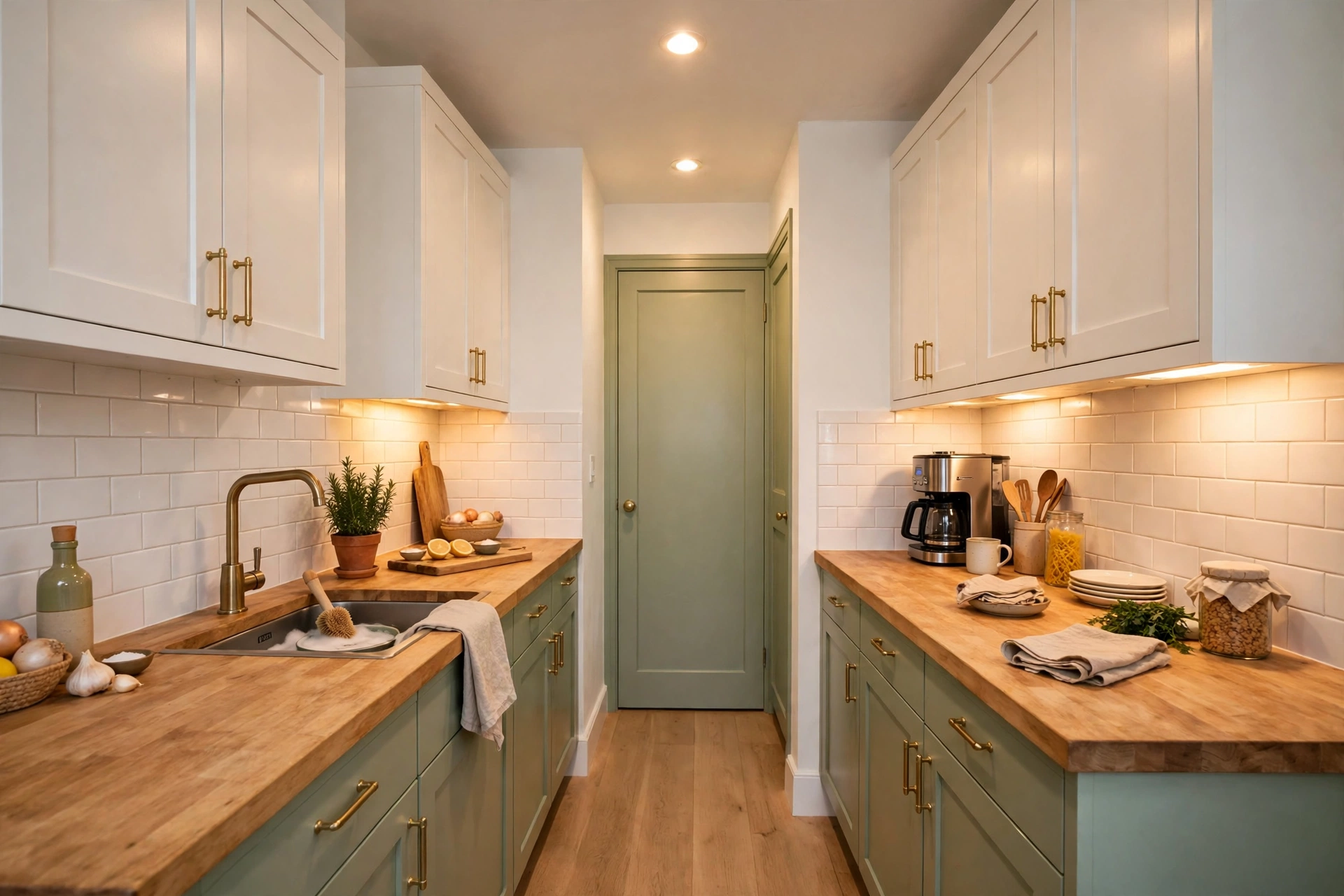
3. Pale sage lowers, white uppers
Sage is a receding color, which means it visually pulls away from the eye and makes a wall feel further back. Paint the lower cabinets a pale sage, keep the uppers and the walls warm white, and the room gains depth without losing brightness. For the wider sage palette, see our guide to sage green and cream kitchen color ideas.
4. Soft blue gray backsplash
A pale blue gray backsplash does two jobs at once. The cool tone recedes like sage, and a glossy tile reflects the under cabinet light back into the room. Keep the cabinets and the walls warm white so the cool backsplash reads as a deliberate accent. White grout keeps the tile field calm; gray grout turns it busy.
5. Go dark on purpose
Remodelista designers say that when there is no hope of brightening a small dark space with windows, the best move can be to go to the dark side, with a deep color such as Farrow and Ball Railings or Off-Black. Keep the dark color to one zone only, dark lower cabinets with white uppers, or one dark wall behind the sink, and keep the lighting strong, with all three layers switched on. Done halfway, with one dim ceiling bulb, a dark kitchen really does feel like a cave.
6. Two tone with warm wood
Warm wood is the fastest way to stop a white windowless kitchen from feeling cold. Use a butcher block counter, open wood shelves, or a wood range hood, and keep the cabinets warm white. The wood adds the warmth the missing sunlight would have given. Oak and maple suit warm whites; walnut suits cooler whites.
7. Glossy backsplash as a mirror
A glossy white glass tile backsplash reflects the under cabinet lights and doubles their effect. It is the closest thing to a window you can put on a wall. Keep the tile pale and the grout white, and carry the tile up to the underside of the wall cabinets so there is no dark gap.
8. Warm metal accents
Brass or warm gold pulls, a brass faucet, and one brass pendant turn a white windowless kitchen from flat into finished. Warm metal catches the 3000K light and throws tiny warm reflections around the room. Keep the metal to one finish and repeat it three times, hardware, faucet, and one light. For a full warm metal pairing, see our guide to cream kitchen cabinets with black hardware ideas, which shows how a dark metal repeat works on cream cabinets.
9. The rental friendly version, no paint at all
Renters can get most of this look without touching a paintbrush. Start with battery puck lights under the cabinets, then add a peel and stick backsplash or one peel and stick wallpaper accent wall, then swap the cabinet pulls for warm brass. Peel and stick wallpaper runs about $30.80 a roll for NuWallpaper Grey Poplin Texture at Home Depot and $37.49 a roll for RoomMates Dimensional Grasscloth, and one accent wall usually needs two rolls. Test a sample on your wall first, because adhesion varies by wall texture and paint age.
What It Costs
Every price below was checked on 24 Nov 2026 from current retail listings. Prices are in US dollars, before tax.
| Item | Price | Best for |
|---|---|---|
| Benjamin Moore Advance, per gallon | $88.99 list | Cabinet paint |
| Sherwin-Williams Emerald Urethane, per gallon | $80 to $109 street | Cabinet paint |
| Brilliant Evolution wireless puck light | $14.99 | Renters, inside cabinets |
| GE Enbrighten LED puck lights, 3 pack | $33.98 | Under cabinet, battery |
| GE Enbrighten Premium 24 inch LED bar | $65.99 | Permanent under cabinet |
| NuWallpaper peel and stick, per roll | $30.80 | Rental accent wall |
| RoomMates grasscloth peel and stick, per roll | $37.49 | Rental accent wall |
A small kitchen usually needs two or three under cabinet bars. At $65.99 each for the GE Enbrighten direct wire bar, that is about $132 to $198 for the permanent route. The battery route is cheaper: one 3 pack of GE Enbrighten pucks at $33.98 covers one cabinet run.
For paint, one gallon of Benjamin Moore Advance at $88.99 list covers the cabinets of a small kitchen, and one gallon of wall paint covers the walls. Budget for primer too if you are painting over a dark color or a glossy surface.
Mistakes to Avoid
The most common mistake is pairing a cool gray white with cool bulbs. A cool white under a 4000K or 5000K bulb doubles the cold and the room feels clinical. If your bulbs are cool, your paint must be warm.
The second mistake is lighting the room with one ceiling fixture only. A single overhead light throws shadows down from the wall cabinets and leaves the counter in the dark.
The third mistake is skipping the test patch. A paint chip is the size of a postage stamp, and a windowless kitchen is lit only by your bulbs. Paint a big patch, live with it for two evenings, then decide.
The fourth mistake is a dark countertop with dark cabinets. One dark surface is a feature; two dark surfaces with no daylight is a cave.
Frequently Asked Questions
What is the best paint color for a small kitchen with no windows?
A warm white with an LRV above 80 is the safest pick. Sherwin-Williams Alabaster SW 7008 at LRV 82 is the most forgiving, because its warm cream undertone stays friendly under artificial light. Benjamin Moore White Dove OC-17 at LRV 83.16 is a good second choice.
What LRV should paint have in a windowless kitchen?
Aim for an LRV of 80 or higher on walls and cabinets, so the paint reflects most of the artificial light back into the room. Benjamin Moore Chantilly Lace OC-65 at LRV 90.04 is the brightest option here, but it needs warm 3000K bulbs.
What color temperature bulbs are best for a windowless kitchen?
Use 3000K warm white bulbs for the whole kitchen, one temperature everywhere. At 3000K, white paint reads as a clean true white. At 5000K daylight it reads blue gray and clinical, so avoid daylight bulbs in a kitchen with no windows.
Can I use a dark color in a small kitchen with no windows?
Yes, but keep the dark color to one zone only, such as the lower cabinets or one wall, and keep everything else white. You also need strong artificial light, with ceiling, under cabinet and accent layers all in place.
How can I brighten a rental kitchen with no windows without painting?
Add battery puck lights under the cabinets, put up a peel and stick backsplash or one peel and stick wallpaper accent wall, and swap the cabinet pulls for warm brass. Battery pucks start at $14.99, and peel and stick wallpaper runs about $30.80 to $37.49 a roll.