Dark Green Kitchen Cabinets With Butcher Block Countertops: 7 Pairings That Work
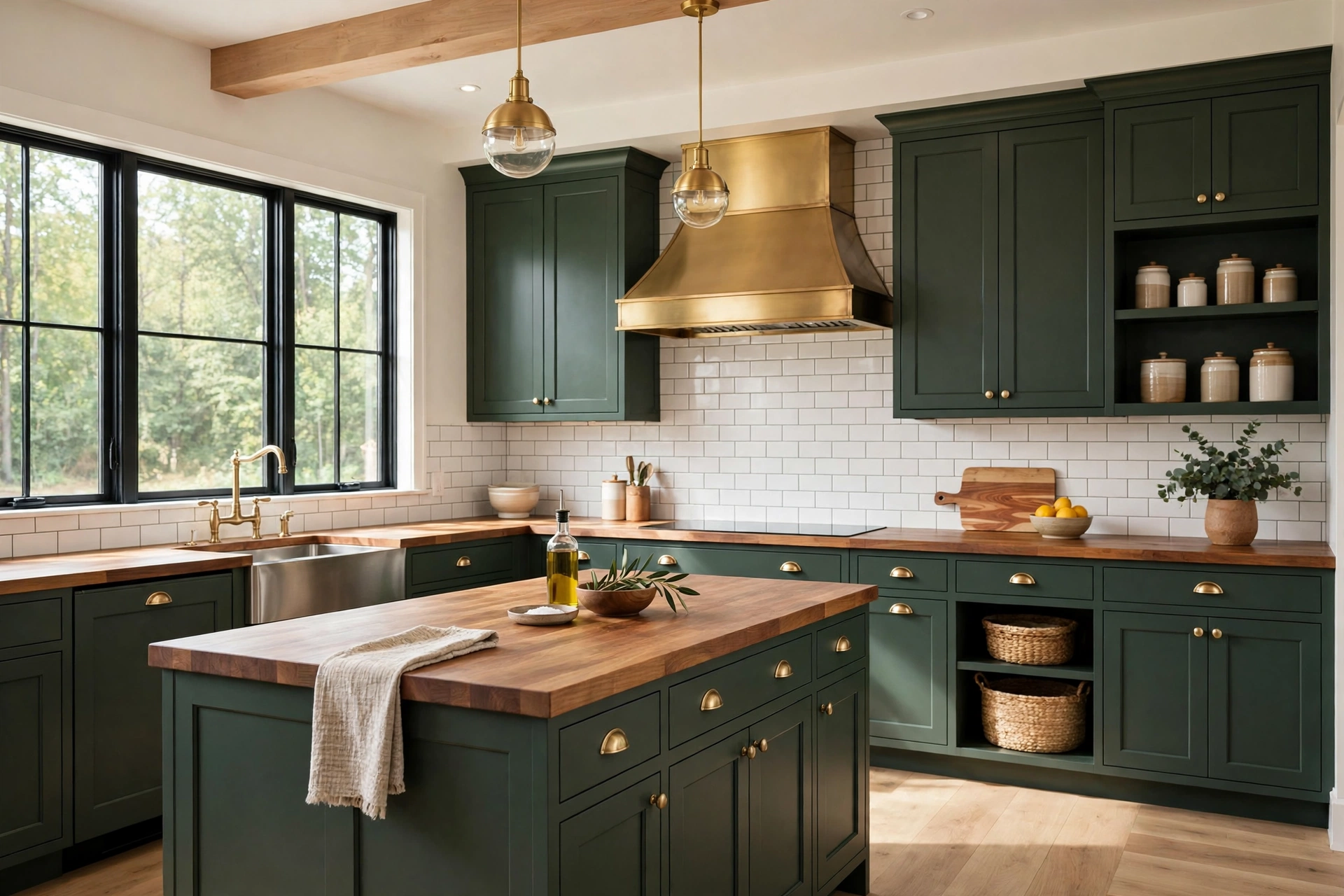
Dark green cabinets with a warm butcher block top work when the green has a warm undertone and the wood is lighter than the paint, such as Pewter Green SW 6208 with pale maple or Studio Green No. 93 with walnut. Keep uppers white or open, add 3000K lighting, and oil the wood monthly so the counter stays sealed.
Dark green cabinets and butcher block is the pairing everyone saves on Pinterest and almost nobody explains. Most guides show three pretty photos and stop there.
This guide fills those gaps: real paint codes, a full oiling schedule, a sink sealing method, an island only version, and a small kitchen version. Every price was checked on 25 Nov 2026.
Will Dark Green Make Your Kitchen Too Dark?
It can look too dark, but only if you get three things wrong at once. Start with the green. Some dark greens lean warm and olive, some lean blue and cold. A warm green sits comfortably next to warm wood, while a blue leaning green fights it. Keep the wood lighter than the paint, because that contrast makes the pairing work. Walnut is the one exception, but it still needs light walls and strong light.
Pick Your Green and Your Wood First
The table pairs six verified greens with the wood that suits each one. Every code was checked against manufacturer and retailer listings. LRV, or light reflectance value, runs from 0 for black to 100 for pure white.
| Green paint | Code | LRV | Best wood | Feel |
|---|---|---|---|---|
| Farrow and Ball Studio Green | No. 93 | n/a | Walnut | Dramatic |
| Sherwin-Williams Pewter Green | SW 6208 | 12 | Pale maple | Most forgiving |
| Benjamin Moore Essex Green | HC-188 | 5.64 | Walnut | Moody |
| Benjamin Moore Salamander | 2050-10 | n/a | Maple | Bold |
| Sherwin-Williams Rosemary | SW 6187 | 14 | Pale maple | Lightest here |
| Benjamin Moore Hunter Green | 2041-10 | 6.39 | Acacia | Classic forest green |
Pewter Green at LRV 12 is the best first try, and Rosemary at LRV 14 is the lightest here. Essex Green at LRV 5.64 and Hunter Green at LRV 6.39 are the deepest, and both demand a bright room, white uppers, and strong lighting.
The Oiling and Sealing Schedule
A new top needs heavy oiling up front, then regular top ups. Skip the schedule and the wood dries out, shrinks, cracks, and stains.
| When | What to do | What to use |
|---|---|---|
| Before first use | 3 to 4 coats, 24 hours apart | Food grade mineral oil |
| First month | Oil once a week | Food grade mineral oil |
| Every month after that | One coat, wipe dry | Food grade mineral oil |
| Every 3 to 4 weeks | One coat of conditioner | Howard Butcher Block Conditioner |
| Every 6 to 12 months | Light sand, then 2 coats | Mineral oil, sandpaper |
| When water stops beading | Oil at once | Food grade mineral oil |
The water bead test is the simplest check you own: if splashed water beads up, the seal is good, and if it soaks in, oil it that day. A top used daily needs oil monthly.
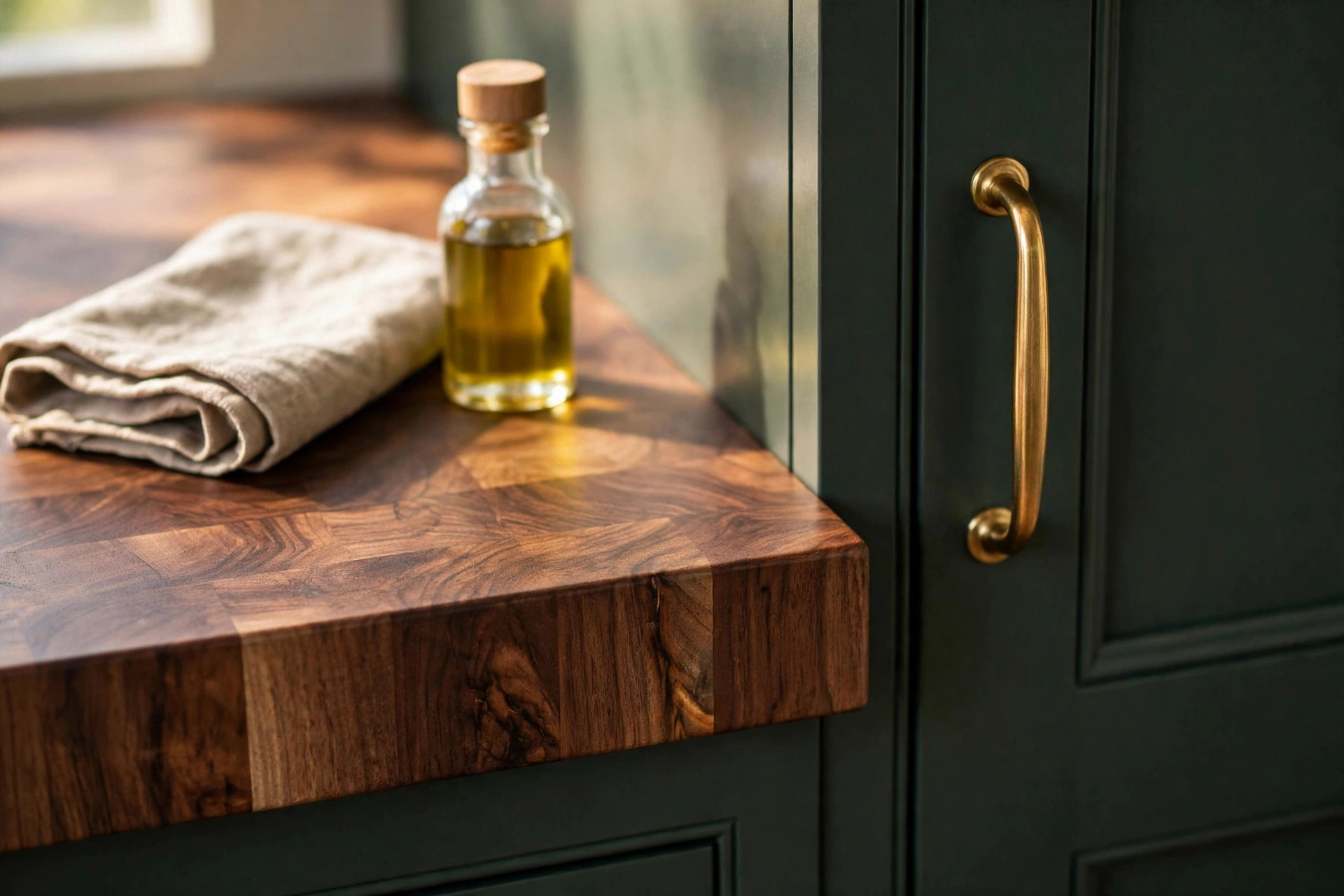
Use food grade mineral oil only where food touches. It is cheap, it never goes rancid, and a quart costs $4 to $8 at any pharmacy. Never use cooking oil, olive oil, or vegetable oil, because those go rancid and turn sticky. Tung oil and Danish oil suit furniture, but they are not food safe. Howard Butcher Block Conditioner costs $9.98 for a 12 oz jar at Home Depot, and Howard recommends reapplying it every 3 to 4 weeks.
How to Seal the Sink Cut-Out So It Does Not Rot
The sink cut-out is where butcher block fails. The rest of the counter gets wiped dry, but the cut-out sits in water all day. Once it stays damp, it swells, darkens, and rots. Sealing it takes an hour and saves the countertop.
Seal the raw cut edges before the sink goes in. Brush food grade mineral oil into the end grain until it stops soaking in, usually 4 to 5 coats, letting each soak for 20 minutes. Then add a waterproof layer over the oil, such as a food safe hardwax oil. Set the sink with a continuous bead of clear silicone sealant under the rim. Oil the cut edges monthly, and wipe up standing water the same day. If the wood around the sink ever turns dark or soft, sand it back to clean wood, let it dry for 48 hours, and re-oil it.
7 Dark Green and Butcher Block Pairings
1. Studio Green and walnut, the classic dark pairing
Farrow and Ball Studio Green No. 93 with a walnut top is the pairing you see in designer kitchens, because both are warm and deep. Keep the walls warm white, use unlacquered brass hardware, and fit a white or marble look backsplash. Save it for a large kitchen, because both surfaces are dark.
2. Pewter Green and pale maple, the safest first try
Sherwin-Williams Pewter Green SW 6208 with pale maple is the pairing to choose if you are nervous about going dark. The maple is so light that the green reads as a color, not as a cave. Add matte black hardware and a white subway tile backsplash.
3. Essex Green and walnut, the moody one
Benjamin Moore Essex Green HC-188 at LRV 5.64 is almost black in low light, so it needs walnut, brass, and strong lighting. Paint the lowers Essex Green, keep the uppers warm white, and run walnut across the whole counter. One brass pendant and 3000K under cabinet lights do the rest. If you want a lighter green instead, our guide to sage green and cream kitchen color ideas shows the softer end of the family.
4. Salamander and maple, the vivid green
Benjamin Moore Salamander 2050-10 is the boldest green here, a jewel tone that stays clearly green even in low light. Pair it with plain maple, not walnut, because walnut fights the brightness of the green. Keep everything else quiet: white walls, a plain white backsplash, and simple hardware in aged bronze or matte black.
5. Rosemary and pale maple, the soft one
Sherwin-Williams Rosemary SW 6187 at LRV 14 is the gentlest dark green here, a warm sage that suits a kitchen with little natural light. Pale maple keeps it airy, and a pale sage or cream tile backsplash ties the two together. It also works with pale blue uppers: see our guide to light blue kitchen cabinets ideas.
6. Island only, the renter and first timer version
If painting every cabinet feels like too much, paint only the island. A dark green island with a butcher block top gives you the whole look for one small paint job and one slab. Use Pewter Green SW 6208 on the base and top it with a 25 by 60 inch maple slab, about 10.4 square feet. Stock maple from Home Depot runs $5 to $15 per square foot, so the top costs roughly $52 to $156 before finishing. Renters can skip paint entirely: an IKEA KARLBY walnut veneer top in the 74 inch length costs $279.
7. Small kitchen version, green lowers only
A small kitchen can carry dark green, but only on the lower cabinets. Paint the lowers in Pewter Green or Rosemary, keep the uppers warm white or open with wood shelves, and use pale maple for the counter. The white uppers bounce light down, so the room keeps its brightness. For the full lighting plan, see our guide to kitchen color ideas for small kitchens with no windows.
Hardware and Backsplash Pairings
Hardware stops dark green and wood from looking like a farmhouse. Unlacquered brass is the classic match: it warms the green and ages into a soft patina. Matte black is the modern match, and it works best with pale maple. Pick one metal and repeat it three times: hardware, faucet, and one light. For more brass ideas, see our guide to navy blue and brass kitchen ideas.
For the backsplash, white subway tile is the safe pick: cheap, bright, and it lets the cabinets and the wood do the talking. Zellige tile in pale cream adds handmade texture, which suits walnut tops. A marble look tile with soft gray veining suits Studio Green and Essex Green. Avoid a busy patterned tile, because the green cabinets and the wood grain are already two strong patterns, and keep the grout white or very pale.
What It Costs
Every price below was checked on 25 Nov 2026. Prices are in US dollars, before tax.
| Item | Price | Best for |
|---|---|---|
| Hardwood Reflections maple panel, material | $5 to $15 per sq ft | Budget maple top |
| Sparrow Peak maple slab, 25 by 96 in | About $130 to $160 | One straight run |
| Sparrow Peak walnut slab, 25 by 96 in | About $280 to $330 | Statement walnut top |
| IKEA KARLBY 74 in, oak veneer | $199 | Island top |
| IKEA KARLBY 74 in, walnut veneer | $279 | Island top |
| Butcher block installed, basic run | $20 to $35 per sq ft | Install |
| 8 ft run installed, all in | $350 to $750 | One straight run |
| Benjamin Moore Advance, per gallon | $88.99 list | Cabinet paint |
| Sherwin-Williams Emerald Urethane, per gallon | $130.49 to $132.49 list | Cabinet paint |
| Howard Butcher Block Conditioner, 12 oz | $9.98 | Conditioning |
| Food grade mineral oil, per quart | $4 to $8 | Oiling |
A typical 10 by 10 kitchen has about 30 square feet of counter. In maple at $5 to $15 per square foot, that is $150 to $450 for the material, or $600 to $1,050 installed. One gallon of Benjamin Moore Advance at $88.99 covers the cabinets. The island only version is far cheaper: a 25 by 60 inch maple island top runs $52 to $156, plus oil at $4 to $8 and conditioner at $9.98.
Mistakes to Avoid
The most common mistake is pairing dark green cabinets with a dark walnut top in a dim kitchen. One dark surface is a feature, but two with no daylight is a cave.
The second mistake is skipping the first oiling. A new top needs 3 to 4 coats before its first use.
The third mistake is using cooking oil as a finish. Olive oil and vegetable oil go rancid, turn sticky, and smell. Use food grade mineral oil only.
The fourth mistake is leaving the sink cut-out raw. The cut edges drink water faster than the flat top, and an unsealed cut-out can rot. Oil the cut edges 4 to 5 times before the sink goes in, seal them, and re-oil them monthly.
The fifth mistake is mixing metals, so pick one metal and repeat it three times. The sixth mistake is painting without a test patch: dark green shifts more than any light color under different bulbs, so paint a large patch and live with it for two evenings.
Frequently Asked Questions
Will dark green kitchen cabinets with butcher block countertops make my kitchen look too dark?
Not if you keep the wood lighter than the paint and light the room properly. Use Pewter Green SW 6208 with pale maple, keep the uppers white, and fit 3000K under cabinet lighting. Save walnut for bright rooms.
Which wood goes best with dark green cabinets?
Pale maple is the safest match for most dark greens, because its light tone contrasts with the paint and keeps the room bright. Walnut suits the deepest greens, such as Studio Green No. 93 and Essex Green HC-188, but it needs a bright room and strong lighting.
How often do you oil butcher block countertops?
Oil a new top 3 to 4 times before first use, then weekly for the first month, then monthly after that. Add Howard Butcher Block Conditioner every 3 to 4 weeks. If splashed water soaks in instead of beading, oil it that day.
Can you put butcher block around a sink without it rotting?
Yes, if you seal the cut-out properly. Brush food grade mineral oil into the raw cut edges 4 to 5 times before the sink goes in, add a waterproof finish over the oil, and set the sink with a bead of silicone sealant under the rim. Re-oil the cut edges monthly and wipe up standing water the same day.
Is dark green with butcher block good for a small kitchen?
Yes, if you keep the green to the lower cabinets only. Paint the lowers in Pewter Green or Rosemary, keep the uppers warm white or open, and use pale maple for the counter. A glossy white backsplash and 3000K lights keep the room bright.